
Particulate matter
sources
impact on health
ecosystems
A question of rights
Particulate matter: an invisible killer
The most harmful air pollutants for human health are carbon monoxide, lead, nitrogen oxides, ground-level ozone, particle pollution (often referred to as particulate matter), and sulfur oxides.
As we launch Sóller per l’Aire we have decided to concentrate on particulate matter, though we will cover the other contaminants, particularly ozone.
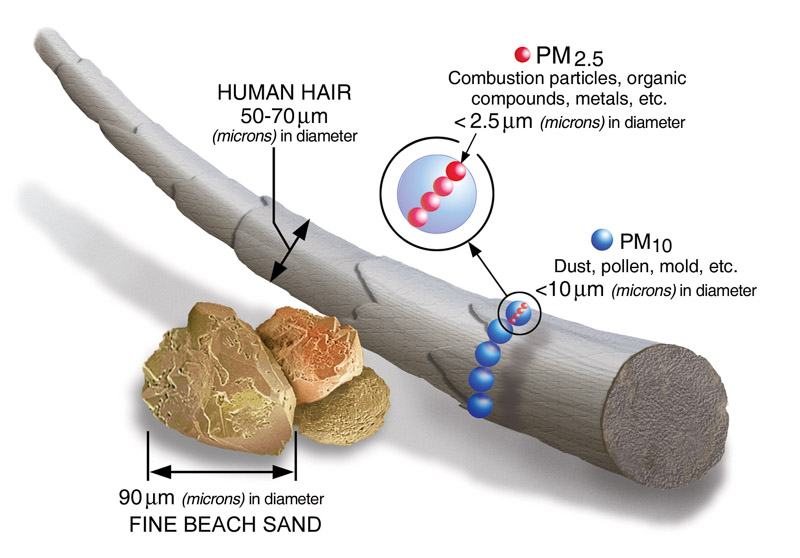
What is PM, and how does it get into the air? Size comparisons for PM particles
PM stands for particulate matter (also called particle pollution): the term for a mixture of solid particles and liquid droplets found in the air. Some particles, such as dust, dirt, soot, or smoke, are large or dark enough to be seen with the naked eye. Others are so small they can only be detected using an electron microscope.
Fine particles can come from various sources. They include power plants, motor vehicles, airplanes, residential wood burning, forest fires, agricultural burning, volcanic eruptions and dust storms.
Studies have found a close link between exposure to fine particles and premature death from heart and lung disease. Fine particles are also known to trigger or worsen chronic disease such as asthma, heart attack, bronchitis and other respiratory problems.
Particle pollution includes:
- PM10 : inhalable particles, with diameters that are generally 10 micrometers and smaller; and
- PM2.5 : fine inhalable particles, with diameters that are generally 2.5 micrometers and smaller.
- How small is 2.5 micrometers? Think about a single hair from your head. The average human hair is about 70 micrometers in diameter – making it 30 times larger than the largest fine particle.
The WHO guideline on air quality stipulates that PM2.5 not exceed 10 μg/m³ annual mean, or 25 μg/m³ 24-hour mean; and that PM10 not exceed 20 μg/m³ annual mean, or 50 μg/m³ 24-hour mean.
Problem displaying Facebook posts.